
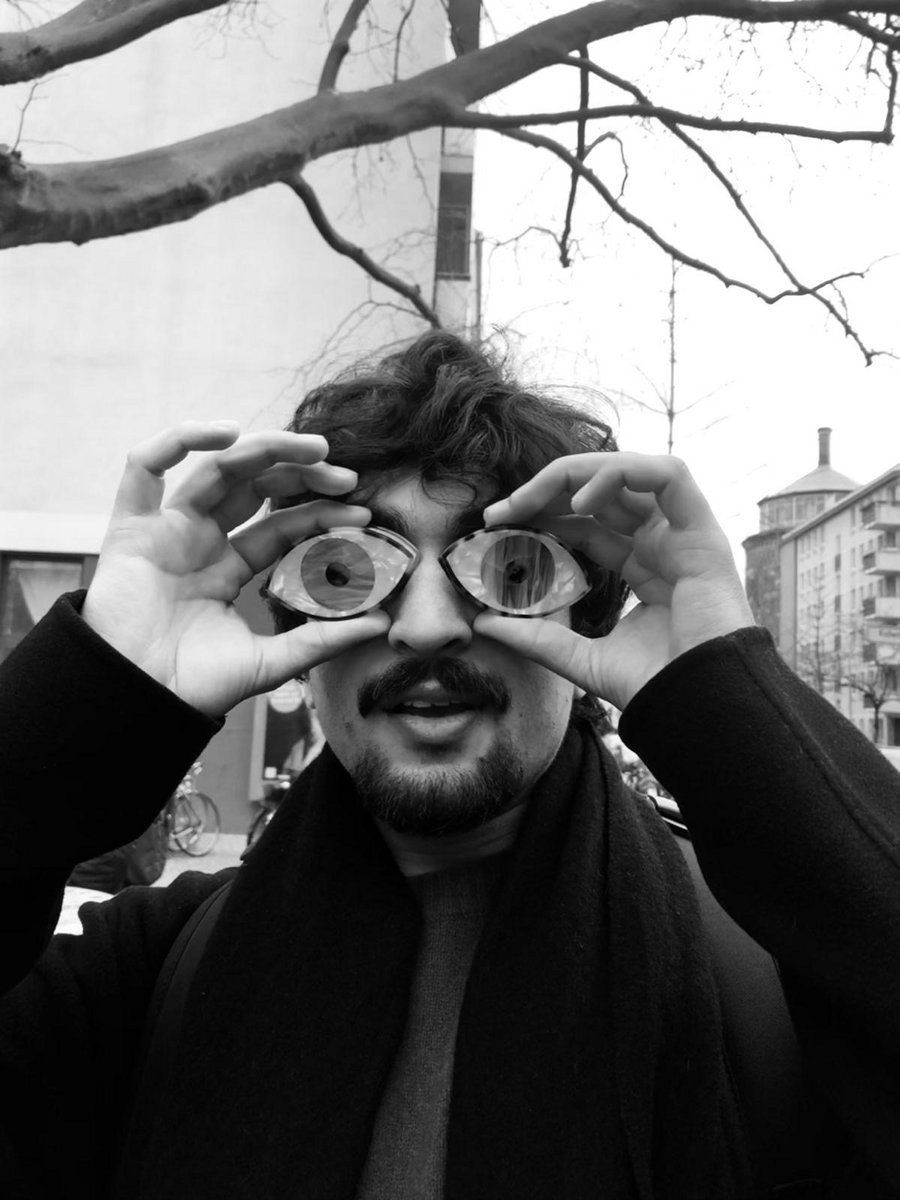
Angad Berar’s latest album, Sundae, feels like the perfect soundtrack for sunlit highways and hazy summer afternoons. Released independently this past June, with vinyl editions from Echodelick and Stickman Records and cassettes via Gezellig, Sundae is Berar’s fourth album and his second full-band recording.
Co-produced with Kartik Pillai (of Karuta Records and known for his work with Jamblu, Begum, and Peter Cat Recording Co.), the record glides on a buoyant fusion of Hindustani psych and krautrock, pulsing with steady, hypnotic grooves and lush textures.
Written between Goa, Delhi, and Berlin over several years, then tracked in a focused five-day session at Pillai’s Faridabad studio, Sundae radiates an easy, forward-driving energy. It also marks a personal milestone: Berar returns to drum-based compositions with newfound confidence, adding dynamic layers and, for the first time, his own vocals on the shimmering “Driving With You.”
We recently caught up with Berar, and he was kind enough to answer our questions about the new record and much more.
Interview with Angad Berar
Third Eye: Sundae seamlessly blends Hindustani psych with krautrock influences. How did you arrive at this particular sound for the album?
Angad: Hindustani music has been the backbone of my work since the first album, Elephants on the Beach. But even before that, I grew up surrounded by it—it’s sort of ingrained in my subconscious. I guess whenever I play the guitar, a part of the composition naturally carries the essence of Hindustani music, whether I intend it or not.
The krautrock influence, on the other hand, has been growing on me slowly but steadily over the past few years. I think I was thunderstruck when I first heard Neu!, followed by CAN, Agitation Free, and others. Their approach felt wide open—motorik, hypnotic, alive.
At the same time, I’ve been in a really positive place in my life. I can humbly say I’m happy—happy with where I am, and the people I’m surrounded by. There’s a sense of hope in the air. And in some indirect way, I’ve come to associate that hope with krautrock—especially Neu!’s style of composition, like the track “Für Immer.” That blend of repetition and motion feels emotionally resonant right now.
After three years of making ambient records, I wanted this one to sound like a full band again, with drums, distorted guitars, and all. A lot of that krautrock energy seeped into the production, and mixed with what was already embedded in me from Hindustani music, Sundae came together in a way that felt both new and familiar.
Third Eye: You’ve described the co-production with Kartik Pillai as “co-flying heavy machinery at this altitude.” Could you elaborate on what that process entailed in the studio?
Angad: The process of working with Kartik Pillai was, surprisingly, very smooth. I had never co-produced an album before—this was my first time sharing that role—so I walked into the project with a bit of concern. But as soon as I flew down to Faridabad and moved into Kartik’s studio for a week—Karuta Records—the process became pretty straightforward and fun.
Kartik is a very centered person—not much fazes him—which, in the best way, created a space where I could just be myself in the studio. It allowed us to experiment freely, without any air of judgment or friction. He’s a big believer in trusting the process, and that mindset really set the tone. We left all the over-analysis and second-guessing outside the door.
I finally had a real person to bounce ideas off of, instead of doing it all by myself in my own head. That made a huge difference.
We worked on one song per day, which was a new workflow for me. I’m usually bouncing between multiple ideas or projects. But Kartik would take one track and focus all his energy on it from morning till evening—really dial in. That kind of single-minded focus takes stamina, and it was inspiring to witness.
Some of the songs—like “Jam 6”—came out of jamming with Kartik’s friend Siddharth, who joined us on drums. We jammed for a couple of days, and some of those sketches ended up on the record.
There was also a lot of room for sonic experimentation. We’d run guitars through different chains of pedals, synths, and ambient effects, and just mess around until something stuck. That sense of playfulness really defined the sessions. It was fun. And it was exactly the kind of collaborative energy I had been looking forward to.

Third Eye: How did writing across Goa, Delhi, and Berlin shape the mood and textures of this album?
Angad: Each city brought its own flavour and mood to the album. Delhi gave the songs a raw edge—something about its dry heat, chaotic traffic, the mix of beauty and noise. “Jam 5” was written there.
The instrumental version of “Driving With You” was conceived in Goa, while riding a scooty along coconut tree–laden roads.
“Jam 3,” on the other hand, got finessed in Berlin—a city that, in my opinion, takes its transitions very seriously. You end up obsessing over small moves, over scene changes. That precision crept into the final layers of the album.
With a city comes its people, food, sounds, textures—they all left their imprint on the tracks.
Third Eye: Sundae features your first-ever vocal performance on “Driving With You.” What inspired you to step behind the mic this time?
Angad: The song was initially meant to be an instrumental—with a working title, “Driving With You.” I had an image in mind: two lovers driving through a beach town, along coconut tree–laden roads.
The day Kartik and I started refining the demo, he began casually singing the title—“Driving with you…”—over the instrumental. It sounded nice. Then he asked me if I’d like to sing it. I was hesitant at first, but thought—why not? This was the whole point of co-producing with someone: to get pushed out of my comfort zone.
I think we wrote the lyrics that afternoon or evening, and the next day we did a couple of vocal takes. And yeah, that was that.
Kartik suggested we add some contrast to the song by introducing female vocals for the chorus. Back in Berlin, I asked Chrisrah to add some backing vocals. Over the weekend, we bought an SM57, treated my bedroom, and recorded the vocals straight into my laptop.
Third Eye: There’s a clear sense of motion and optimism in Sundae. Were there particular experiences or moods that you wanted the album to evoke?
Angad: Exactly that—positive, locomotive. One way to look at Sundae is as a playlist made for driving. A steady rhythm keeps the momentum going, and each song has its own distinct rhythm and feel—each one inspiring a slightly different kind of movement as the album progresses.
Leaning on my previous answer, I wanted this album to also reflect my state of mind. I feel like I’m in my positive era (hahaha)—surrounded by loved ones, feeling happy. I wanted this project to reflect that.
Third Eye: If Sundae were an actual ice cream sundae, what flavors and toppings would it have?
Angad: Coincidentally, while answering these questions, I was passing through San Gimignano and tried this incredible gelato—pistachio with a swirl of forest berries: strawberries, blueberries, blackberries, raspberries.
It immediately felt like Sundae in edible form. The pistachio is rich, earthy, grounding—like the drone and groove at the core of the album. And the forest berries bring in that tangy, unpredictable swirl, like the melodic improvisations and bursts of texture Kartik and I leaned into. A bit sweet, a bit strange, but somehow it all works together.
Third Eye: If you could time-travel to see any krautrock or psych band live in their prime, who’s on your list?
Angad: Agitation Free during their 2nd era, Neu! between ’72 and ’75, and CAN in the Damo Suzuki years—’70 to ’73.
Third Eye: Finally, summer 2025 is upon us. Where do you imagine fans listening to Sundae this summer?
Angad: I imagine it playing from a car stereo while driving through winding mountain roads, or through headphones on a morning cycle past open fields. Maybe it’s playing softly while someone runs along a beachside promenade, waves on one side and the day opening up on the other.
Anywhere the landscape is moving and the listener is in motion—that’s where Sundae feels most at home.

Leave a Reply