
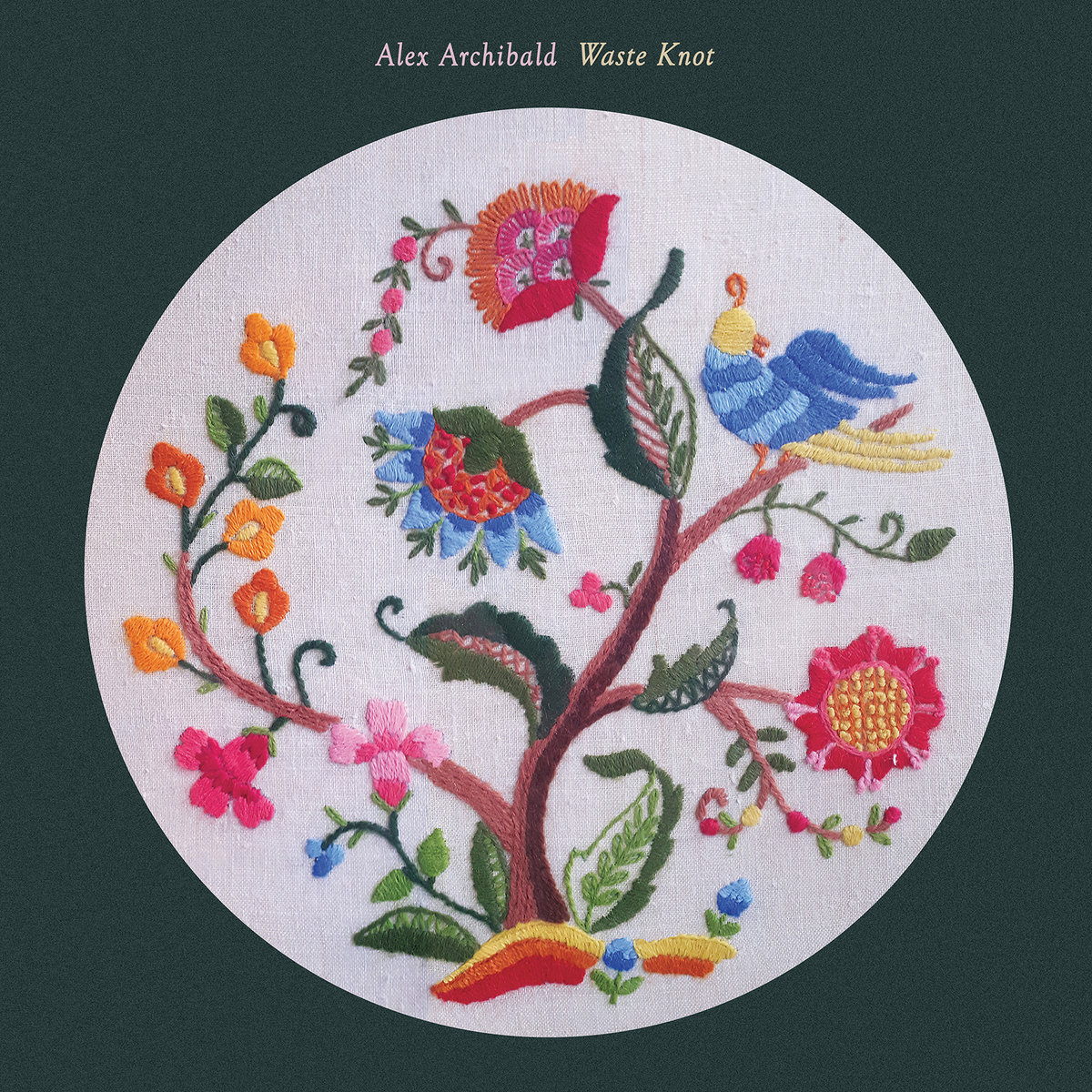
Glad Tidings, a new Vancouver-based label that launched over the summer, chose a fitting first release: Waste Knot from guitarist and composer Alex Archibald. Recorded outdoors along the West Coast, Waste Knot invites listeners into a world where the natural environment becomes an uncredited collaborator.
Across the record, Archibald plays with radiant openness. The opening tracks glow with bright, sun-drenched energy, while later pieces drift into deeper, more mysterious territory, eventually settling into twilight.
Though he could be grouped with today’s solo-guitar revivalists, Archibald draws from a wider orbit: the microtonal wanderings of Kostas Bezos, the devotional grace of Emahoy Tsegué-Maryam Guèbrou, raw blues, Moondog’s minimalism, Django’s swing, and even the punk brevity of the Minutemen.
We recently spoke with Alex about improvisation, the process of playing guitar and creating new songs, and who he’d like to colloborate with.
Interview with Alex Archibald
Third Eye: Can you introduce yourself and your music? And can you tell us more about the new label, Glad Tidings?
Alex Archibald: My name is Alex Archibald. I live and work as a house painter in Vancouver, BC, Canada. The music I play was heavily influenced early on by discovering John Fahey, Robbie Basho, Glenn Jones, and Jack Rose, all within a week or so in 2010, and just becoming obsessed with that kind of acoustic guitar music for a while.
I was just playing with a rudimentary kind of off-kilter pattern-based guitar picking for myself at the time (which was really fun to do but also felt clunky and excessively laborious), and it felt like a good moment to hear that stuff.
Since then, I’ve been more influenced by Old Time (as in very much pre-bluegrass, fiddle-led, ensemble-based) and blues music recorded in the 1920s and 30s, as well as certain older African, Greek, and Hawaiian music, some Jazz and rock, and whatever, weird individuals of no particularly well-defined genre, and so on. I’m sure it’s not all super apparent in my music. It just comes out as it does, and I try to keep it interesting and fun and challenging for myself.
With Glad Tidings, I think we’re trying to hopefully cast a little more light on some of the more acoustic-based and partly experimental stuff that’s out there. We have an appreciation for traditional music of different kinds, so music that comes from a place of an awareness of that world (whether it cares about fitting that mold at all or not) will have a place, I’d say.
Vancouver seems a bit more preoccupied with things other than these. There’s lots of great music here, of course, but hopefully we’ll contribute somewhat to filling what feels like a bit of a void in our region. And hopefully we end up with something interesting, worthy of listening to in that regard. My label partner Lorna and I are very much on the same page aesthetically but our ideas will evolve over time I’m sure.

Third Eye: How do you balance spontaneity with structure when composing instrumental guitar music like this?
Alex: Most of the songs I’ve recorded are in their own tunings, with a few repeat tunings. I love the feeling of discovering things that feel new and unexpected to me in that way, but constantly changing tunings also keeps me from getting super comfortable in any one of them.
That being said, I do my best to improvise because it’s really fun for me, even when it sounds terrible and I find it very slowly becomes more intuitive in general over time. On this album the song “Whittling” is an improvisation bookended by a set phrase, The first half of “Chowderhead” was improvised and maybe 50 percent nailed down during the time it took to record it and small sections of other pieces are basically open for limited improvising.
It keeps the piece alive and breathing for me I find, and the more structured parts are also open for changing and shifting as I play them more. But I tend to move on to new songs anyway when it comes to my own stuff.
Third Eye: There’s a palpable sense of joy and presence in your playing. Is making music a form of meditation or grounding for you?
Alex: Making music is definitely a meditation and is definitely grounding for me. It’s a bit like keeping a journal which helps me to feel a sense of continuity in my life. Each piece has its associations for me. Some are more deliberate and more tangible and some are more subtle and hopefully help exorcise thoughts and feelings that I couldn’t put into words, but they all feel necessary for me at the time I’m working on them.
I love the process of playing and writing. Less so recording, but I’ve always had a kind of simple drive towards putting an album together. Finishing a record is a bit like filling a sketchbook. There’s a kind of clean slate feeling. Empty pages. A fresh Beginning. It’s a small part of the motivation, which is another way to keep it feeling creative and properly meditative, and a healthy habit to have.
Third Eye: Waste Knot fits perfectly alongside many releases I have covered recently from artists like Joseph Allred, Kevin Coleman, and Levi J. Burr. If you could collaborate with someone in this growing and eclectic outsider folk scene, who would it be?
Alex: I absolutely love Joseph Allred’s playing. It has so much power and so much nuance to it, a combination of extremes that blend so seamlessly together and feel so effortless. A real sincere beauty to his music. I wouldn’t presume to try to find a place for me to fit in, however. I really love the Old Time Fantasias record, all of it but also especially Ditch Lily Suite. That one is triumphantly well made and engaging to me. But his solo playing is inspired.
I think as far as collaborating goes, the Magic Tuber Stringband is pretty high on my list of favourites these days. Amazing guitar from Evan Morgan and the brilliant fiddle playing of Courtney Werner and the blend and balance of simplicity and gorgeous, confident complexity is truly a kind of magic to me. Again, I don’t know how I’d fit in anywhere but I’ve always loved the idea of mixing what I do with other instruments, fiddle and banjo in particular. That’d be awesome. Not happening that way, but they inspire me.
Finishing a record is a bit like filling a sketchbook. There’s a kind of clean slate feeling. Empty pages. A fresh Beginning.
Third Eye: Say someone picks up Waste Knot in a record store in 2045. What do you hope they feel when they press play?
Alex: I hope that they might feel a connection to it somehow in a way that feels helpful, hopeful. I’m often filled with anxiety and anger at the way the world is going, the seeming futility of things. Hopefully, something in what I’m doing helps remind somebody else of something hopeful or useful.
Third Eye: Now that this record is out in the world, what’s next for you and the Glad Tidings label?
Alex: Well, we’re not aiming in any way to be a home for solo guitar records. My album just happens to be what we had to work with. That being said, there might be a little more guitar on the not too distant horizon as well as some more experimental acoustic offerings, but I don’t wish to say too much at the moment.


Leave a Reply