
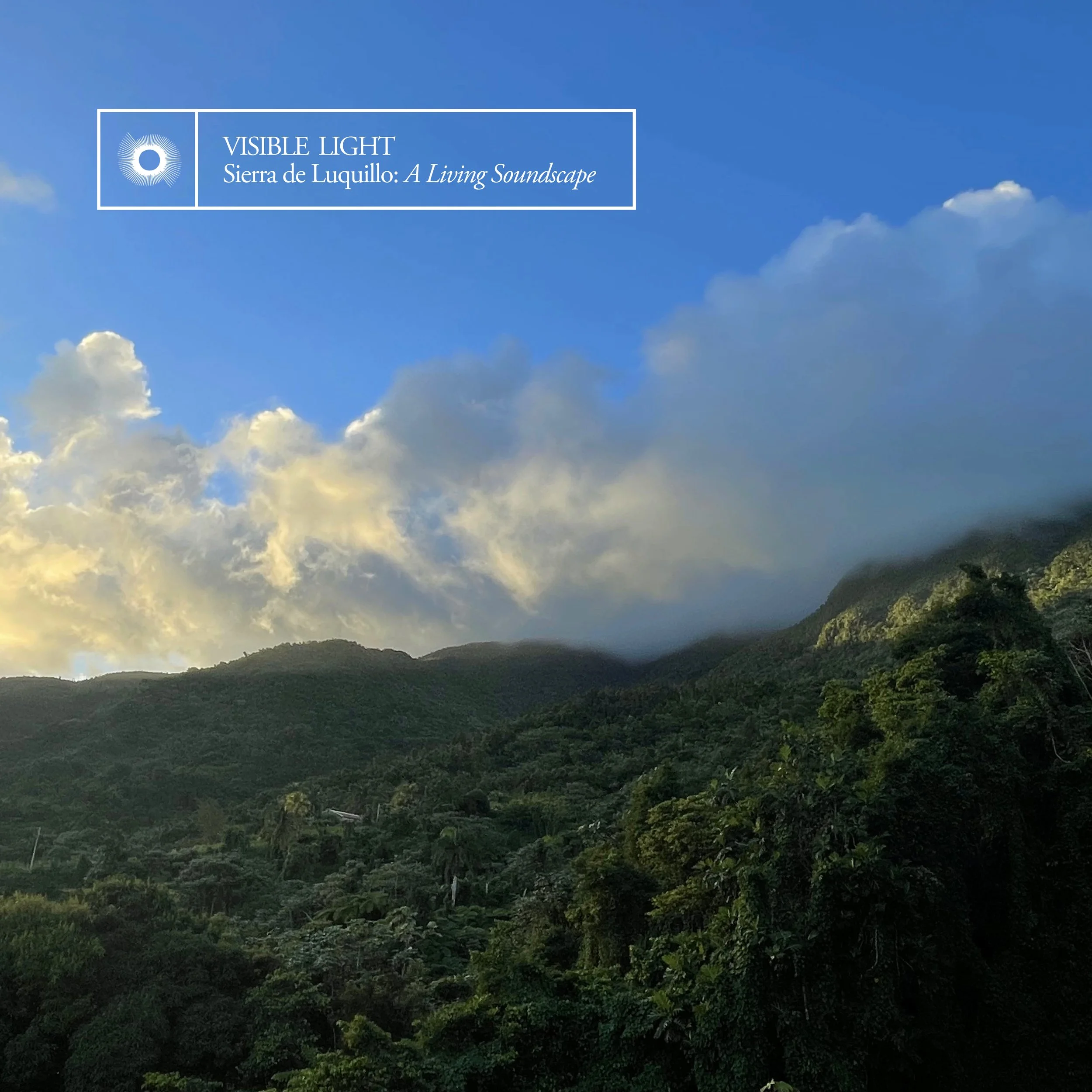
Sierra de Luquillo: A Living Soundscape is the second album from Visible Light, the chamber-ambient duo of cellist Amy McNally and sound artist Matthew Hiram. It’s out June 22nd via Permaculture Media, timed to World Rainforest Day. It follows their well-received 2025 debut Songs for Eventide, but where that record offered music for the shift between light and dark, this one drops you directly inside one of those shifts, into the El Yunque Rainforest in northeastern Puerto Rico, after the sun has gone down.
El Yunque is the only tropical rainforest in the U.S. National Forest system, more than 28,000 acres of cloud-soaked mountain that the Taíno called Yuke, “white lands,” for the thick clouds that ride the peak. It’s home to 240-plus tree species, hundreds of rare animals, and, most importantly for this album, the coquí frog, Puerto Rico’s national symbol, an amphibian whose call has been clocked at 90 to 100 decibels.
After dark, the forest doesn’t quiet down so much as switch frequencies. McNally and Hiram carried in battery-powered gear and let it run. The result isn’t a “field recording album” in the documentary sense. They captured the coquís, the wind moving through the canopy, even bio-electric signals from the plants themselves at the mountain’s peak, and then composed cello, flute, synthesizer, brass bowls, and gong around all of it.
If you keep an eye on the more contemplative corners of underground music, the album’s “for fans of” shortlist is a strong tell: JD Emmanuel, Jasmine Guffond, Simon McCorry, the Cosmic Tones Research Trio. I’d throw Popol Vuh’s Aguirre onto the pile, the slow-burn passages of Terry Riley’s organ work, and the gentlest end of Pauline Oliveros’ deep listening catalog. Anything where the act of paying attention is itself the practice. The mastering, fittingly, is by Chuck Johnson at Cirrus Oxide, which on its own is a kind of stamp of quality for anyone who’s spent time with his pedal-steel ambient records.
The album moves in four long movements, each one a phase of a single night. “La Oscuridad” is dusk arriving, with the forest pricking its ears up, cello tones bowing low, and the coquís starting one by one until they’re a full chorus. “Música de las Plantas” is the album’s strangest and most haunted piece, built from bio-electric data captured from the plants at the mountain peak.
“La Tormenta” is the storm, with rain falling gently but steadily, distant thunder rolling under the canopy, with brass bowls and gong opening up the room. By the time you get to “Medianoche”, darkness is at full crescendo, and the forest, as the duo puts it, “sings with us.” The frogs and the cello are doing the same thing now. You can’t quite tell where one stops and the other starts.

This is also a project with its convictions worn openly. The sound collection was harm-free and non-invasive; proceeds from the release go to the Borikua Taino Foundation, an Indigenous-led nonprofit focused on land stewardship and cultural work on the island; the physical edition is a limited run of 25 four-panel digipaks, pressed on FSC-certified recycled board with eco-friendly ink.
The piece was originally composed for a 24.2-channel ambisonic system and premiered at Reforester’s Laboratory in Brooklyn last October. What you’ll hear at home is a careful binaural/stereo translation, but the spatial intent is intact. Headphones, a dark room, and a generous hour of your evening are the way in.
“The song is in the air, for those who choose to listen,” the duo writes in the album notes. That’s the whole posture of this record. Fans of JD Emmanuel, Simon McCorry, Pauline Oliveros, and Chuck Johnson should dig this one deeply, and so should anyone who’s been looking for something patient and beautiful to put on after the sun goes down. Enjoy.
Support Visible Light on Bandcamp/Spotify/Apple Music.
Find Amy McNally on Instagram and Matthew Hiram on Instagram/Substack.
Support Permaculture Media on Bandcamp & all links.
Learn about the Borikua Taino Foundation and consider donating here.


Leave a Reply