
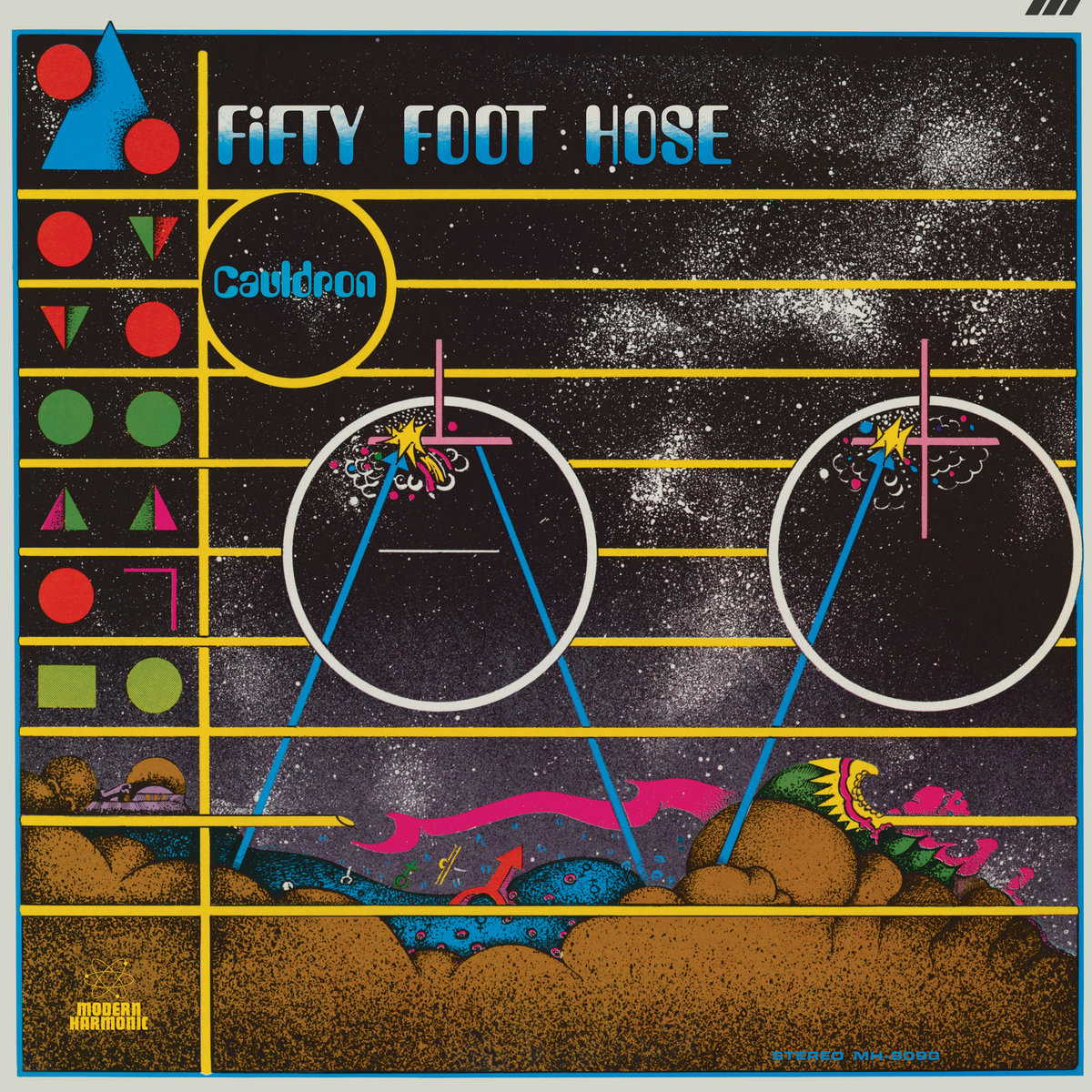
San Francisco in the late ’60s was, of course, overflowing with psychedelic bands, but very few pushed the form as far into the future as Fifty Foot Hose.
While Jefferson Airplane, Quicksilver Messenger Service, and The Dead were stretching the possibilities of rock through improvisation and heavy doses of LSD, Fifty Foot Hose were building their own strange electronic instruments out of theremins, fuzzboxes, cardboard tubes, and even a WWII bomber speaker.
Led by bassist and tinkerer Louis “Cork” Marcheschi, the band didn’t just want to soundtrack the counterculture. They wanted to rewire its very frequencies.
Their only album of the era, Cauldron (1967), is a collision of psych rock, jazz sensibility, avant-garde composition, and primitive electronics. Guitarist David Blossom and his wife, vocalist Nancy Blossom, brought melody and structure into the fold, while Marcheschi’s home-built machines splattered white noise, oscillations, and alien sound effects across the mix.
Marcheschi was interested in the ideas of experimental composers like Terry Riley and John Cage, and it certainly shows. The result is a record that feels at once dated to its moment and shockingly ahead of its time.
Tracks like “Fantasy” and “If Not This Time” anchor the record in the familiar psych-rock orbit, marked by acid guitars and breathy vocals, but then “Red the Sign Post” detonates with proto-punk ferocity, pushed into the red by squelching electronics.
Their cover of Billie Holiday’s “God Bless the Child” feels almost sacrilegious, a jazz standard turned inside out by echoing effects and a weird, haunted delivery.

On a record already packed with oddities, the title track stands out as the strangest, and that’s saying something.
Nancy Blossom’s voice circles through sing-song, nursery rhyme–like lines, warped and bent by electronic treatments until it sounds more like a ghost in the machine than a lead vocal. The effect is eerie and unsettling, and perfectly emblematic of the band’s willingness to push rock into alien territory.
Elsewhere, songs like “Rose” and “The Things That Concern You” lean closer to classic ’60s psych, but much of the album is anything but conventional. The opener “And After” ditches rock altogether, offering more than two minutes of ominous electronic textures. “Bad Trip” plunges headfirst into musique concrète, a chaotic barrage of unidentifiable sounds.
“Skins” manages to straddle experimentation and cohesion, while the nearly twelve-minute “Desire” delivers the record’s purest psych jam. It’s a hypnotic, slow-burning sprawl that ties together the album’s strange journey.
At its strangest, Cauldron prefigures industrial music and noise rock, sounding closer to Throbbing Gristle or Pere Ubu than their San Francisco contemporaries.
It’s no surprise, then, that the record sold poorly at the time. Cauldron was simply too strange, too abrasive, too forward-thinking for the average Haight-Ashbury head, no matter how far out they thought they were.
But while the album may not have sold many copies upon release, Fifty Foot Hose cultivated a devoted cult following in San Francisco’s psychedelic scene. They shared bills with acts as varied as Blue Cheer, Chuck Berry, and Fairport Convention, the lineup bolstered at times by bassist Robert Goldbeck.
By late 1969, however, the band had dissolved. Most of its members transitioned into the cast of the musical Hair (which paid much better), with Nancy Blossom taking the lead role in the San Francisco production before going on to perform in Godspell.
Guitarist Larry Evans returned to his hometown of Muncie, Indiana, where he led several local club bands until his passing in 2008.
Cauldron was Fifty Foot Hose’s only record, and, over time, its reputation has grown. When the album was reissued in the ’90s, a new generation of listeners recognized its role as a missing link between psych rock and the experimental electronics that would come to define post-punk and industrial music.
By the mid-’90s, Marcheschi had established himself as a respected sculptor, creating large-scale public works that blended neon, plastics, and kinetic design. Yet his musical vision wasn’t finished. In 1995, he revived Fifty Foot Hose with a new lineup for a series of San Francisco performances, which culminated in the release of Live & Unreleased and, two years later, the studio album Sing Like Scaffold.
Marcheschi continued to blur the boundaries between art and sound. In 2006, working with David Funk and Kim Johnston, along with producer Konstantine Baranov under the name CWRK Musical Environments, he helped install a permanent sound sculpture in a Hong Kong atrium, a project that perfectly captured his lifelong fascination with immersive environments.
Listening now, Cauldron feels like an artifact from a parallel history of psychedelic music, one where the boundary between rock and electronic experimentation collapsed decades earlier. It remains both an acquired taste and a visionary document, maybe something for fans of that great Beefheart cult classic, Trout Mask Replica.
If Jefferson Airplane were the sound of dropping acid in Golden Gate Park, Fifty Foot Hose were the sound of that trip going extraterrestrial, terrifying, and utterly unclassifiable.


Leave a Reply