
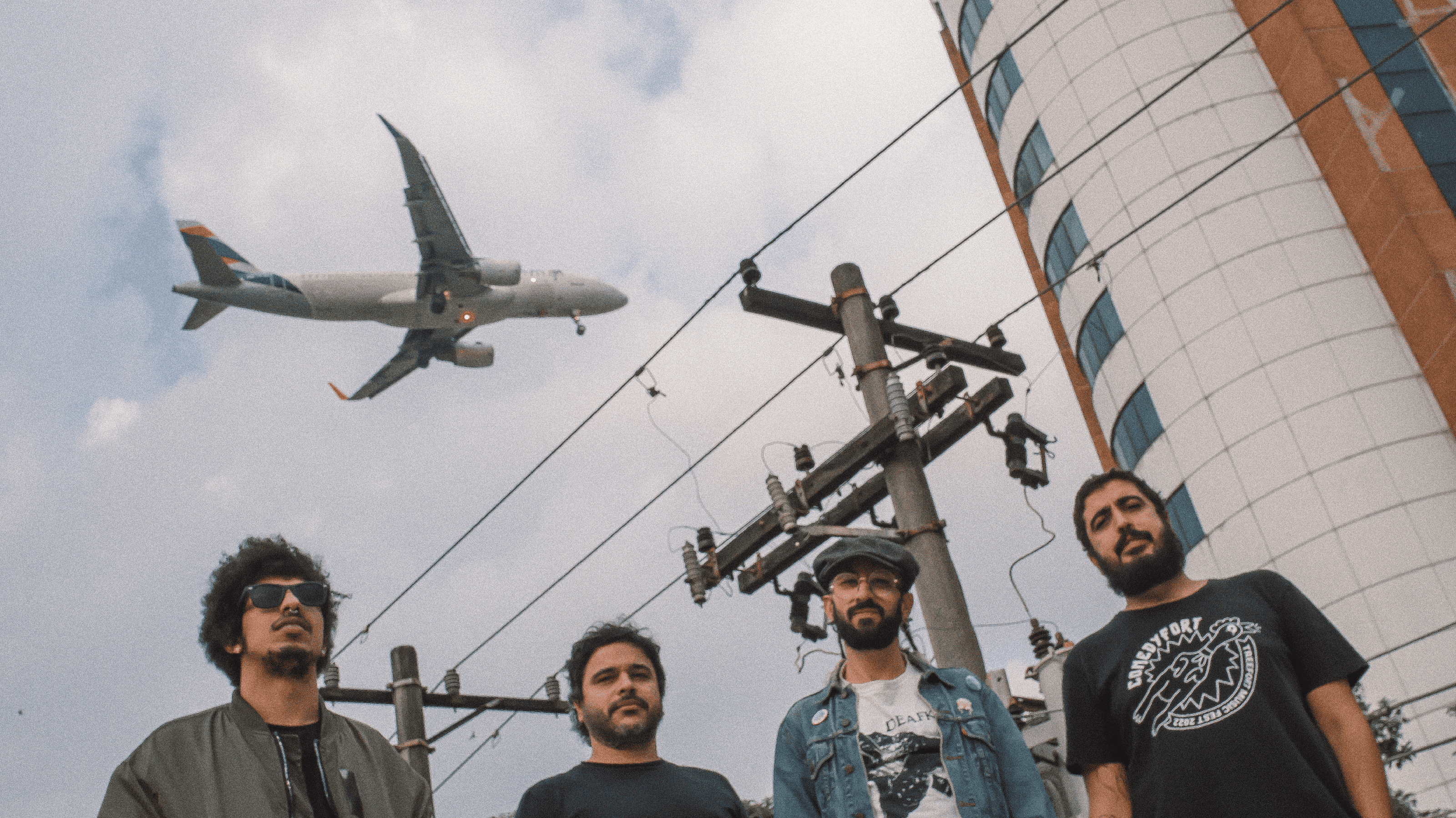
Brazilian psych rockers BIKE recently returned with “Sucuri,” the first glimpse of their upcoming sixth album Noise Meditations (out this September).
Marking ten years of sonic exploration, the new single draws from Kaxinawá myth and pulses with ritualistic grooves, noisy improvisation, and a sense of trance-like transformation. Since their 2015 debut, the São Paulo-based quartet has evolved into one of the defining forces in the global underground psych scene, taking their expansive sound from local stages to festivals like Primavera Sound and SXSW.
With Noise Meditations on the horizon, we caught up with BIKE to talk about mythology, how their sound and philosophy has evolved over the years, and what comes next for the band.
Interview with BIKE
Third Eye: “Sucuri” draws from the Kaxinawá indigenous myth of Yube and the serpent. How did you first encounter this story, and what drew you to translate it into music?
Julito: Since our last album, Arte Bruta (2023), which is all about ayahuasca, I’ve continued researching native cultures and their legends. During one of these studies, we came across the legend of Yube and the Sucuri. Yube falls in love with a female Anaconda and follows her to the bottom of the lake. He becomes a male Sucuri and is introduced to a hallucinogenic drink with healing powers and access to knowledge.
Thus, we return to the ayahuasca we discussed so much on the last album, providing continuity from one album to the next. Our idea is to continue this musical and historical research of our roots and blend it with what we consume from abroad. At the end of the lyrics, when we talk about the Sucuri, the idea is to let it guide us to the drink of knowledge, so that we can continue creating freely.

Third Eye: You’ve called “Sucuri” a call to reconnect with our primal selves. In today’s crazy, fast-paced modern world, what does “listening to our instincts” mean to you personally?
Julito: I think that in today’s connected world, we have to stop, breathe, and follow our instincts at some point. If I think about the current music market, where social media follower numbers and digital platform plays, even though they’re often purchased and artificial, end up being the guide for many curators and concert producers who base their work on these factors rather than on the music they create, I’d end up creating something artificial that doesn’t align with my thinking, but rather with what the market demands at the moment.
As a band, we believe in being free, creating our own path, and not worrying about the current sound or trends when making our music. Noise Meditations is undoubtedly the most instinctive album we’ve ever made. We just went into the studio, turned on the equipment, and played whatever we wanted, switching between instruments to create what became the album. During the recording, we played everything live, together, and with a lot of energy to sound as real as possible.
Third Eye: This year marks a decade of BIKE. How has your sound and philosophy evolved since you began?
Julito: When the band first started, we were deeply involved with the New Psychedelia sound propagated by Tame Impala, Pond, KGLW, Temples, and other bands from the 2010s. After releasing our second album, we began a much broader exploration of Brazilian music from all eras, including krautrock, noise, Indian, and Arabic music, which greatly expanded our sound on subsequent albums. Our relationship with psychedelics also changed. What was once merely recreational and for partying became an important part of our daily lives and creative studio sessions.
Life on the road also shaped this evolution. We’re from the countryside of São Paulo, so when we started playing in the capital and traveling to other states, our minds opened up and continued to open up with tours in Europe and the US. Understanding what a real tour is like, what the music market is like in different parts of the world, and the audience’s relationship with music in each location are all crucial to our growth and evolution as a band and artist.
Just like Yube, we have been diving deeper and deeper in search of cures and knowledge, after all, it is still very difficult to make music in Brazil and even more difficult to leave here and show this music around the world.
Third Eye: You have fans across Brazil, Europe, and the U.S. How do different audiences respond to your music? Do you feel different energies in different parts of the world?
Diego: Yes, definitely! Outside of Brazil, the experience of our show is more immersive for the audience, who truly pay attention and consume the show. Here, people sometimes just want to post a story to say they went to the show. Brazilians enjoy love ballads, radio hits—everything that’s missing from a BIKE show. And we feel that psychedelia is more consumed outside of Brazil; there’s been a strong scene there for decades.
Third Eye: From what I’ve heard, BIKE is part of Brazil’s growing psychedelic music movement. How would you describe this movement to someone outside Brazil, and where do you see it headed?
Julito: The beginning of psychedelia in Brazil was in the 1960s with Tropicália. Since then, we have continued to have psychedelic albums in Brazilian music, such as the albums by Udigrudi from Pernambuco in the 1970s, Jupiter Maça with the classic “A Sétima Efervecencia” from 1997, and this revival of new psychedelia in the 2010s. Between 2013 and 2017, many psychedelic albums were released by Brazilian artists.
I could mention as the main albums of that period Tagore’s “Pineal,” My Magical Glowing Lens’ “Cosmos,” Glue Trip’s first album, Boogarins’ “As Plantas Que Curam,” and our first album, “1943.” Despite the recognition these albums received, a large psychedelic scene did not form here, but many of these bands gained recognition abroad and continue to tour Europe and the US to this day. Last year, we played more shows abroad than at home.
Third Eye: What’s the most transformative live music experience you’ve had as an audience member, and how does it inform your own performances?
Julito: The first time I saw a Sonic Youth show was in 2005 in Brazil, that day I felt what it was like to make free music.
Diego: Joe Lally in 2011 at Hocus Pocus in São José dos Campos. I was able to help organize and open the show with my band at the time. It was a lesson in music, DIY, and the independent scene. I didn’t see Fugazi when they first came to Brazil, but I got to play with one of them.
Daniel: Robertinho Silva in São Paulo in 2011. I’d listened to Robertinho a lot on various albums by artists like Milton Nascimento and Airto Moreira, but in this show, he showed me live the most authentic Brazilian way of playing all the influences of universal music. Since then, that’s what I’ve strived to do in my music.
Gil: For me, it was watching shows by former members of Pink Floyd (David Gilmour, Roger Waters) with my father, and understanding how much psychedelic rock unites loves and transcends time.
Third Eye: Last question – what’s next for the band after the release of Noise Meditations? Do you have any upcoming tour plans?

Julito: We’ll release the vinyl in September, before the album hits digital platforms. We already have some shows on the Noise Meditations tour. We’ll play four shows in the UK in September, and in October we’ll play shows in four capitals in northeastern Brazil and Brasília.
In November, we’ll play shows in the south of the country, and at some point this year, we should do a release show in São Paulo. We should continue with shows throughout Brazil, some shows in Latin America, and another tour in Europe in the first half of 2026. In the second half of the year, we should release the seventh album and return to touring.
Pre-order the vinyl of Noise Meditations by BIKE here
Support BIKE: Bandcamp | Instagram | Facebook | Official Website | YouTube


Leave a Reply