
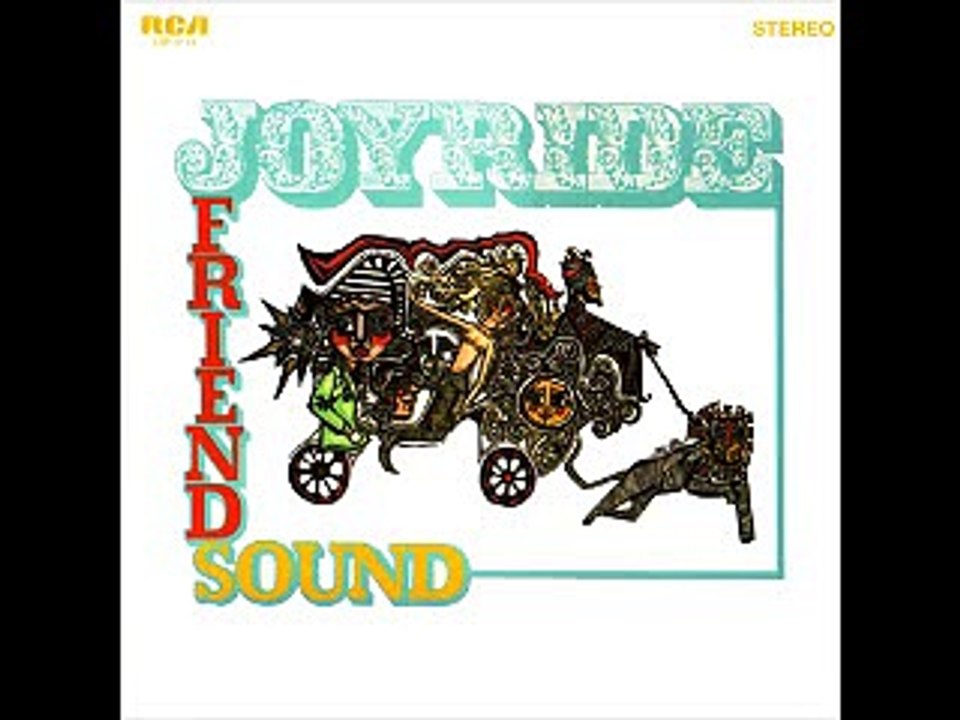
The only release under the name Friendsound, an experimental alias of the American rock band Brotherhood, Joyride emerged in April 1969 via RCA Victor.
This was no ordinary record. It was a bold foray into uncharted musical territory, born out of an impromptu jam session—a “musical free-for-all”—with friends.
The result was a trippy, unsettling kaleidoscope of sounds blending psychedelic rock, electronic experimentation, musique concrète, spoken word, and bursts of noisy guitar, all layered with studio wizardry that turned the control console itself into an instrument.
One track, “Childsong,” features a recording of band member Phil Volk singing as a toddler, a weird touch that added a further strange undercurrent to the avant-garde chaos. Though critics admired its daring creativity, Joyride was a commercial flop.
Decades later, it found new life in the 2014 compilation The Complete Recordings, garnering the appreciation it always deserved.
Brotherhood, formed by Phil Volk, Drake Levin, and Mike Smith after leaving Paul Revere & the Raiders, didn’t hesitate to experiment.
Released under the pseudonym Friendsound, Volk described Joyride as a “psychedelic adventure into Never-Never Land.” Building on the sound effects-heavy approach of their 1968 self-titled album, the group turned their attention to crafting an “aural portrait of the darker side of Los Angeles life.”
The album’s six tracks feel less like songs and more like abstract soundscapes. Take “Love Sketch,” a swirling exercise in stereo recording techniques, or “Lost Angel Proper St.,” a sprawling cacophony that feels more like an art installation than a traditional rock track.
The irony of the album title is evident. Joyride takes listeners on an unsettling journey, with nods to Frank Zappa’s sprawling Uncle Meat.
The creative process behind Joyride began with a spontaneous jam session, where the band recorded unfiltered improvisations. Tracks like the title piece and “Lost Angel Proper St.” originated here, later adorned with flute, dialogue, and sound effects.
“The Empire of Light,” recorded in a single late-night take, leaned heavily on organ and piano. “Childhood’s End” and “Childsong” ventured into musique concrète, blending field recordings with experimental musical textures.
One of the stranger moments comes at the end of “Childsong” when Volk’s voice surfaces in a haunting, spacey echo. It’s a recording of him singing “On a Slow Boat to China” and “If You Call Everybody Darling,” captured at a carnival by his mother. Years later, Volk recalled how hearing his own voice played back sparked his lifelong love of music.
Joyride didn’t find an audience at its release, but critics were intrigued.
Lana Harvey of The Edmonton Journal called it a “beautifully created” record, praising its spontaneous, experimental energy. A reviewer for Australia’s The Age found it “absorbing,” though likely too sophisticated for “teeny-boppers.”
Over the years, the album has gained cult status.
In 2014, the reissue as part of The Complete Recordings allowed a new generation to discover it. Critics like Dan Forte lamented its initial obscurity, celebrating the experimental spirit and bold guitar work of the late Drake Levin.
Music historians have compared Joyride to other experimental gems of the era, even linking it to the avant-garde works of artists like John Cage and the sprawling freak-outs of bands like Amon Düül II.
Today, Joyride is recognized as pioneering in psychedelic and experimental rock. As Record Collector aptly puts it, it’s a “bonkers album,” one that dares to push boundaries without slipping into self-indulgence.


Leave a Reply