
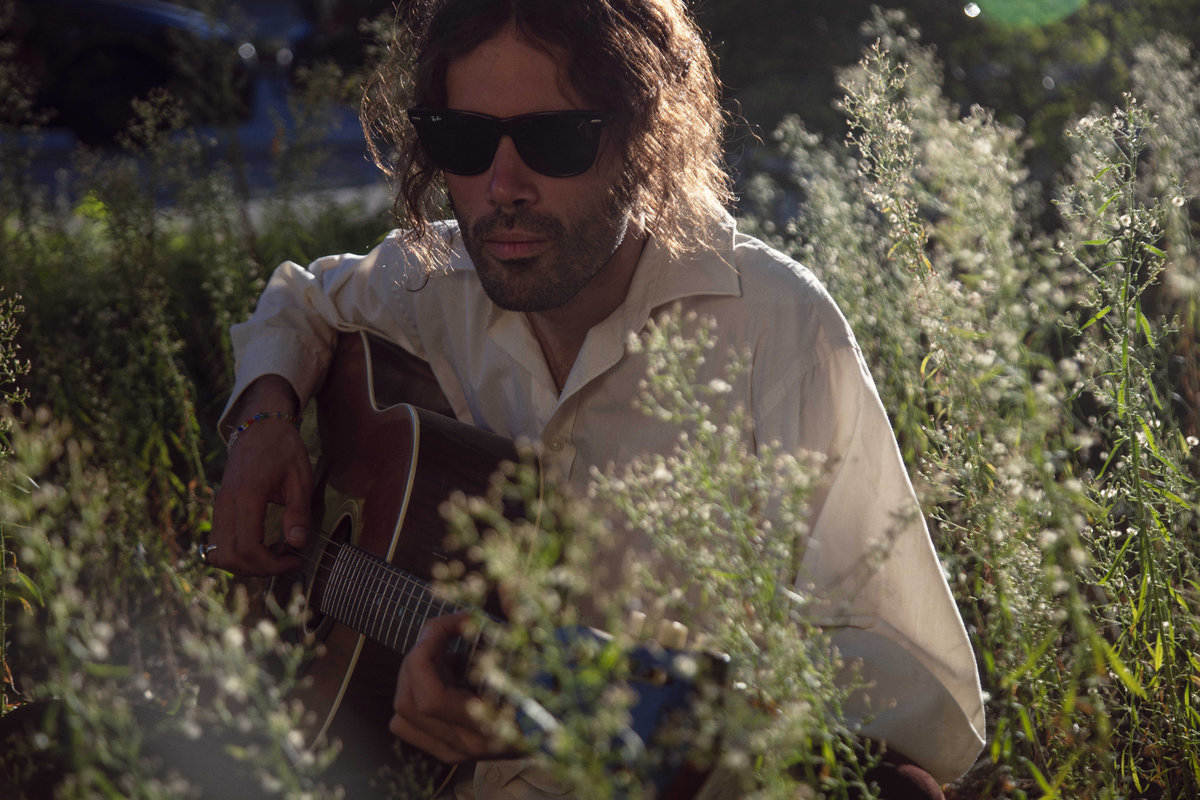
Chicos de Nazca, formerly of Santiago, Chile, and now based in Berlin, recently released their 12th LP, Freshera. The psych rock band’s driving force, Francisco “KB” Cabala, formerly of the bands Cindy Sisters and La Hell Gang, have had quite an epic musical evolution.
From their early days of playing their special recipe of South American psychedelia on the streets of Santiago with a raw, young energy, complete with fuzzed up spaced out guitar and a healthy dose of wah, to their new home in Berlin, a recording studio, and a more refined sound.
In this interview conducted by Third Eye guest contributor Ariel Christopher, KB Cabala talks about his recording studio, moving from Santiago to Berlin, and his new album teeming with love songs which, he tells us, has a “dreamy soul touch.”
Interview with Francisco “KB” Cabala of Chicos de Nazca

Ariel: When did you open your recording studio in Berlin?
Francisco: When I moved to Berlin in 2014, I sold all my studio equipment in Chile and, as I arrived in Berlin, I got a Tascam 16 track tape machine (that is the one I still use), a Tascam mixer and an amplifier and I made a little studio in the basement of a friend where I recorded the album Ether. After that, I moved to the studio of a friend who has a krautrock band called Camera. In that studio, I recorded the album Step Back To Get Up, and after that, I finally found my own space five years ago, where I built my studio called Reflex Magnet.
Ariel: Did you choose to live in Berlin, and if so, why?
Francisco: A friend of mine, with whom I made my first band, Cindy Sisters, moved to Berlin in 2012. In 2014, I got an Italian passport thanks to my grandfather. I then visited my friend in Berlin with the plan to make a change, and I stayed here, and I loved the city, the way of living, the flow of people, the community, and the music/musicians. Then I met my girlfriend here five years ago with whom I have a young daughter growing up here, so yeah, it has been my home for nine years.
Ariel: From the photos, it looks like you have some really nice vintage equipment and instruments. Can you tell me more about your recording equipment and your philosophy about recording?
Francisco: I have good amplifiers, Vox and Fender, some nice vintage mics, a big Tascam mixer where I connect my Tascam 16 track tape machine, some analog reverbs, tube compressors/preamps, and stuff.
I do it very simply; I make sure the sound from the room and mic is the way I want and mostly record pure to tape, with some balance, panning here and there. I like to keep naturality and dynamics. I know how my monitor sounds so that I can mix freely.
I have a collection of guitars. I had three guitars stolen during 13 years of touring, but I still have my little collection, electrics and acoustics, and many organs, synths, bass, drums, and all the stuff that make part of my studio, and I keep collecting equipment. Germany is good for that.
A love for analog tape

Ariel: Have all your records been recorded on analog tape?
Francisco: All the first albums were recorded on 8-track tape. When I moved to Berlin, I got a 16-track tape machine. Two albums were made on digital but with a tape mastering because we didn’t have a reel to reel in the studio we were recording in. But I like the 8-track format; you go minimal, and there’s not much to get lost.
Ariel: To what do you attribute your affinity to analog tape?
Francisco: I like the sound, especially the guitar sound. It keeps the wave as it sounds, and harmonics stay alive; it’s not digital numbers. I really enjoy the analog sound, as it melts into your ears, and you can keep listening, the guitars coming straight from the amps… always when I can, tape is the choice.
Ariel: I noticed that some of the albums are recorded in other recording studios. Can you comment on that?
Francisco: Yeah, we recorded Living Lightime in a studio in Berlin called Funkhaus (that used to be the DDR Radio, built in the ’50s); it was recorded on digital but with nice equipment and a super good sounding room. Another album, Love Triumph, was recorded in Santiago, Chile, in a friend’s studio (a guy who used to have a band called Watch Out!), also digital but with nice analog equipment.
Step Back to Get Up was half recorded by me and another half in a friend’s studio in Berlin called Monoton, which was full tape. Another never-released album called Since You Got It was partly recorded in Monoton, partly at BYM Records, and partly in my studio. I recorded all the rest in my studio or at BYM Records.
‘Magic of the unexpected flow’
Ariel: What was (is?) the BYM recording studio in Chile like?
Francisco: BYM Records has a really nice studio with a big 16-track tape machine. There, we recorded the second album, Fire Ride, the fourth album, Blowing Inside (with my brother Carlos on bass and Nes Rodriguez, Hell Gang’s drummer, the same setup for Living Lightime), and one-half of Since You Got It.
All of La Hell Gang’s albums were recorded there, except for a single called “9 Miles”, which I recorded in Berlin, also released by Mexican Summer Records. Nes runs the BYM studio and label with the help of his brother JP, who played bass on Fire Ride, Since You Got It, and half of Love Triumph.

Ariel: In a 2014 interview, when you were asked what it’s like recording La Hell Gang, you answered: “I don’t think it’s too difficult getting the final album when you are telling the truth. I don’t like it when music is too controlled and planned. I like spontaneity in the music”. Is that still the case, or has your philosophy changed?
Francisco: Yeah, true; with La Hell Gang, much material came from jams. Mostly, all the songs had just a little structure, then the magic of the unexpected flow, as the solos go completely free, and we had some signs to come back to the main riff. With Chicos de Nazca also, pretty much all the solo melodies come at the moment. Sometimes, I record a lot of takes, and I choose the best melodies; weed helps a lot for that 🙂
Ariel: I noticed you have used a lot of slide guitar on the newer albums. Is slide guitar the new wah?
Francisco: A friend of mine was playing his lap steel on a tour we made in 2019 during the recording of this unreleased album Since You Got It, so he recorded some lap steel, and I liked it; I love country music. Sometimes, I play the slide on my guitar as well.
Touring the U.S. in a van
Ariel: You have such an extensive and diverse catalog of music. I can’t wait to hear what the next release brings.
Francisco: Thanks, yeah, and I have a lot of unmixed albums that are waiting on tape to be mixed too, so I have a lot of work to do.
There are eleven albums With Chicos de Nazca, but the last three I just released are streaming myself, the same with two others in the past, Rainbow See the Seal and Submarine Life (they only have a 7” single version release). Only six albums were released on record labels, so it has been changing free all the time, with no expectations.
With La Hell Gang, there are two official releases: one EP, one 7”, and a cassette with demos and live versions.
The next album is almost ready; it’s called Freshera and has a dreamy soul touch. I have recorded all the instruments myself, and it has a fresh energy to me.
Ariel: Did La Hell Gang end up touring the United States in a van, and if so, what was that like? How did you find the states? Road stories?
Francisco: Yeah, we did a tour there for a month in 2014. First, we arrived in New York to play a show for the label we were with at the moment, Mexican Summer, and we played some shows near there in Philadelphia. Then we moved through Cleveland to Detroit and then to Chicago.
A friend from a band called Bitching Bajas drove us in his van around there and played the keyboards for some shows in Milwaukee, Madison, and more. Then, we rented another car and made it from Seattle to San Diego, passing through Oregon and Nevada. It was a lot of fun. It was the only time I toured in the US. I don’t remember it all so well; I remember Detroit was so interesting, like a ghost town during the day and packed in the night.
This interview was conducted by Third Eye guest contributor Ariel Christopher.
Support Chicos de Nazca by finding them on Bandcamp or social media (Facebook, Instagram).
Like what you read? Then consider supporting The Third Eye on Patreon.
Sign up for email updates from The Third Eye below:


Leave a Reply