
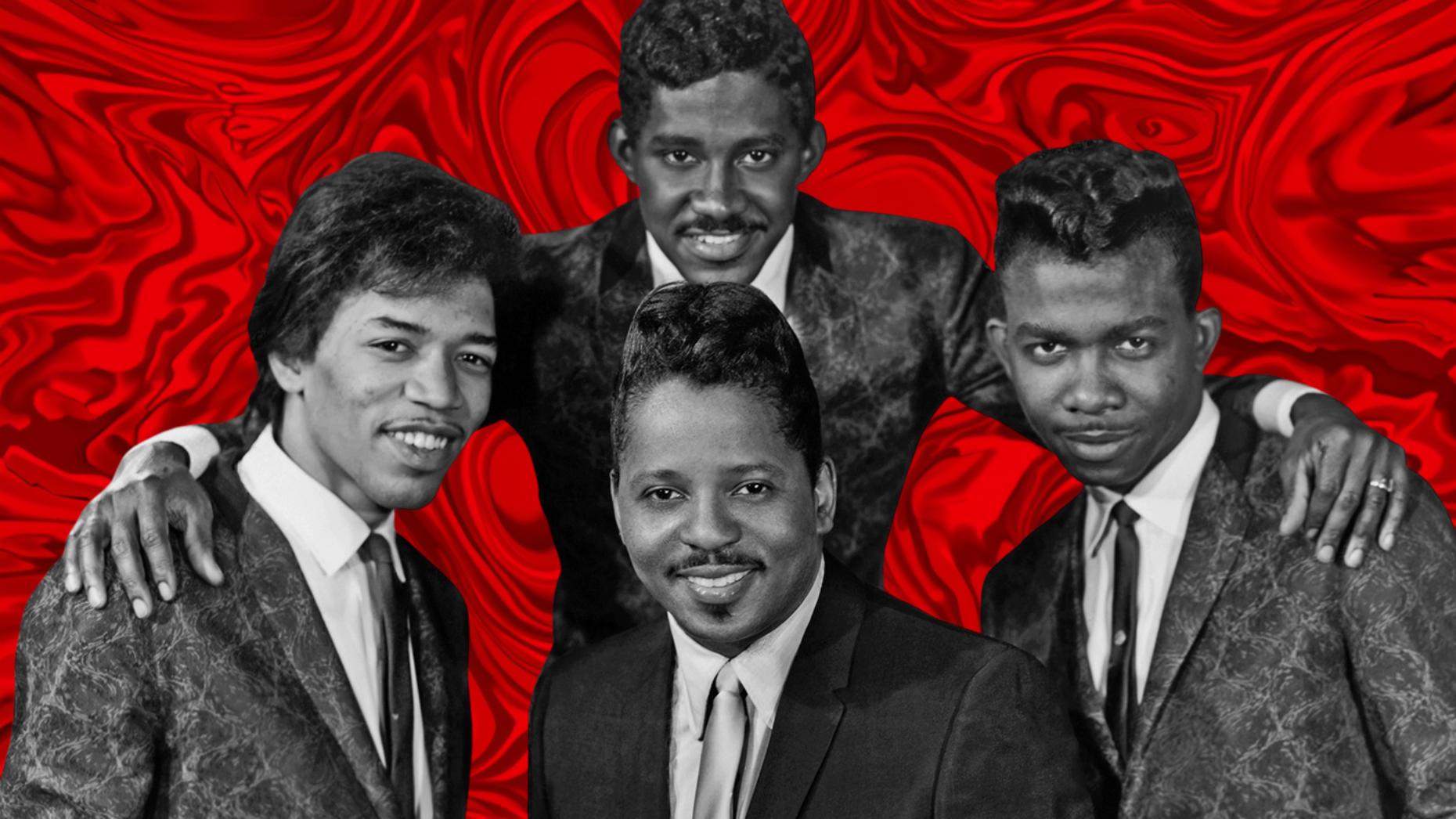
Before the myth calcified — before Monterey and London — Jimi Hendrix was moving through a very different landscape: army barracks, Southern club circuits, and the tight, unforgiving economies of working bands.
In September 1962, freshly discharged from the Army, Hendrix relocated with bassist Billy Cox to Clarksville, Tennessee, just across the state line from Fort Campbell. There, they formed the King Kasuals, a band that, like many of its time, existed somewhere between survival and aspiration. The gigs were small, the pay inconsistent, but the proving ground was real.
It was in this period that Hendrix began absorbing and reworking the physical language of performance. Inspired by players like Butch Snipes and fellow guitarist Alphonso “Baby Boo” Young, he picked up the now-iconic trick of playing guitar with his teeth. Years later, Hendrix would half-joke that in Tennessee, you had to play like that “or else you get shot,” a line that reads less like humor and more like a coded acknowledgment of the competitive, sometimes volatile environments these musicians navigated.
By late 1962, the King Kasuals had drifted toward Nashville, settling into Jefferson Street. At the time, it was the city’s Black cultural and musical core—a dense strip of clubs, lounges, and late-night rooms where rhythm and blues evolved in real time. The band secured a short residency at the Del Morocco, one of the area’s key venues, before folding into the broader Southern touring network known as the Theater Owners Booking Association—or, more colloquially, the Chitlin’ Circuit.
This was the real education. Night after night, Hendrix moved through a circuit that demanded discipline as much as invention. Sets had to be tight, solos had to serve the bandleader, and showmanship had limits. Within those constraints, he sharpened his instincts while working as both bandleader and sideman, backing artists like Wilson Pickett, Slim Harpo, Sam Cooke, Ike & Tina Turner, and Jackie Wilson. The work was steady, but the structure was rigid—sidemen followed rules, and Hendrix was already chafing against them.
By January 1964, that tension broke. Feeling boxed in artistically, Hendrix left the circuit and moved to Harlem, taking a room at the Hotel Theresa. There, he connected with Lithofayne Pridgon—“Faye”—a Harlem native whose support and social network gave him a foothold in a new scene.
Harlem offered something the Southern circuit could not: permeability. Hendrix began playing club dates, sitting in with bands, testing ideas in looser, less hierarchical environments. In February 1964, he entered—and won—the amateur night competition at the Apollo Theater, a small but symbolic victory that marked his transition from regional player to someone beginning to register in a larger musical ecosystem.
Not long after, an audition with The Isley Brothers led to a spot in their backing band, the I.B. Specials. It was another sideman role, but this time, closer to the center of things.
The mythology of Hendrix often begins with an explosion—with feedback, distortion, and spectacle. But the more revealing story is this earlier one: a musician moving methodically through circuits designed to contain him, learning their limits from the inside, and slowly, inevitably, preparing to break them.


Leave a Reply