
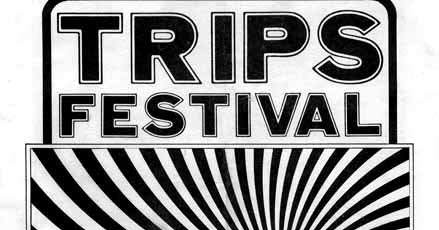
In the swirling haze of the 1960s counterculture, a single weekend at San Francisco’s Longshoreman’s Hall changed everything.
The Trips Festival—a three-day celebration of music, art, and experimentation—marked the beginning of what would become the hippie movement and the explosion of psychedelic culture.
Produced by Ken Kesey, Stewart Brand, and Ramon Sender, with contributions from the Merry Pranksters, Owsley Stanley, and other avant-garde visionaries, the festival was far more than a concert.
It was a sensory revolution, an invitation to lose oneself in a vibrant, immersive experience where sound, light, and creativity collided in unpredictable and transformative ways. As Tom Wolfe famously wrote in The Electric Kool-Aid Acid Test, “The Haight-Ashbury era began that weekend.”
Over 10,000 people flooded into the Longshoreman’s Hall between January 21 and 23, 1966, many eagerly partaking in LSD-spiked punch as they wandered through a landscape of experimental theater, dance, film projections, and live music.
Performers and attendees alike were swept up in an atmosphere of communal exploration and artistic chaos, where the line between audience and artist dissolved.
The festival showcased a remarkable array of talents. The San Francisco Mime Troupe performed provocative theater, the Dancer’s Workshop turned movement into storytelling, and the San Francisco Tape Music Center offered electronic compositions.
A light show illuminated the hall, bathing attendees and performers in a dreamlike glow. Yet, amid this eclectic tableau, the performances by the Grateful Dead, Big Brother and the Holding Company, and Jefferson Airplane became the heartbeat of the event.
The Trips Festival marked the Grateful Dead’s first major San Francisco performance, a band destined to define the city’s psychedelic rock scene.
Their hypnotic jams, amplified by Ken Babbs’ sound engineering, created a sonic experience like no other. Babbs had reworked the hall’s sound system to eliminate distortion, ensuring every note reverberated with clarity and power—no small feat given the venue’s challenging acoustics.
Big Brother and the Holding Company, another emerging band, found their identity at the festival. Among the crowd was David Getz, a painter and jazz drummer, who would soon join the group, helping to cement its place in music history.
The Trips Festival was a flashpoint that sparked an entire movement. The multi-sensory experience it pioneered became the blueprint for San Francisco’s music scene, where venues like the Fillmore Auditorium and Avalon Ballroom embraced the union of music, light, and psychedelia.
Two weeks later, Bill Graham took over the Fillmore, advertising its first weekend as the “sights and sounds of the Trips Festival.”
For many, this weekend in January 1966 was a gateway to a new lifestyle. It wasn’t just the birth of the hippie counterculture; it was the moment when art, music, and consciousness collided, creating an enduring cultural ripple that would spread far beyond San Francisco.


Leave a Reply