
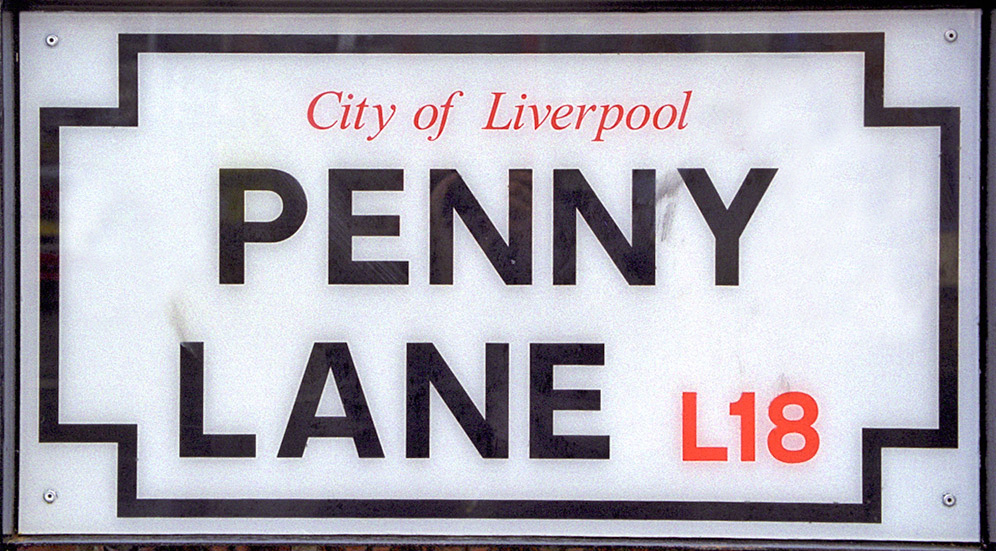
The Beatles’ 1966 hit “Penny Lane” is one of the most beloved songs in the band’s catalog. But what was the inspiration behind the song?
“Penny Lane” was released in 1967 as a single with “Strawberry Fields Forever.” It was written primarily by Paul McCartney but was credited to the McCartney-Lennon partnership. The lyrics refer to a street in Liverpool, mentioning the sights and characters that McCartney remembered from growing up in the English city.
The Beatles recorded “Penny Lane” in 1966 and intended to use it on Sgt. Pepper’s Lonely Hearts Club Band. After it was released as a single to satisfy their ravenous record company, The Beatles stuck to their policy of omitting the single and previously released material on a new album. “Penny Lane” was a top-five hit in Europe and topped the U.S. Billboard charts. The Beatles eventually included the song on the U.S. Magical Mystery Tour album in 1967.
So, what about the actual, real-life Penny Lane? It’s a road in the south Liverpool suburb of Mossley Hill. The name also applies to a roundabout at Smithdown Place with a major bus terminal. It was a frequent stopping place for Lennon, McCartney, and George Harrison when they were students and school kids. Bus trips via Penny Lane and the area became familiar elements in the songs Lennon and McCartney wrote in the band’s early years.
Lennon’s original lyrics for “In My Life” also included a reference to Penny Lane. Soon after the band recorded “In My Life” in 1965, McCartney mentioned to an interviewer that he wanted to write a nostalgic song about Penny Lane. McCartney also said that Dylan Thomas’ poem “Fern Hill” partly inspired “Penny Lane.” McCartney and Lennon wrote the lyrics together, which Paul said was a moment of reliving their childhoods.
There’s also a possibility “Penny Lane” was one of The Beatle’s early psychedelic-tinged songs. The writing of the song took place during the Sgt. Pepper’s sessions and Beatles biographer Ian McDonald suggests an LSD influence on the song. McDonald says the lyrical imagery correlates with McCartney first dropping acid in late 1966, adding that the lyrics have many acid-tinged phrases. Music critics have also described the imagery of “Penny Lane” as “essentially ‘Liverpool-on-a-sunny-hallucinogenic-afternoon.”
There are also plenty of cheeky, hidden meanings in the lyrics, many sexual and drug related. For example, the verses that describe the fireman with an hourglass. “And in his pocket is a portrait of the Queen/He likes to keep his fire engine clean/It’s a clean machine.” Some commentators suggest this is about the fireman fantasizing about and masturbating to a picture of the Queen. Apparently, he often does this because “it’s a clean machine.”
Nowadays, Penny Lane has become a tourist attraction for Beatles fanatics, offering Beatles-theme dining, memorabilia, and probably tons of people hawking merch at the corners. The barber’s shop in the song is still there, but most of the other places that appear in the lyrics are gone. The shelter in the roundabout where “the nurse sells the poppies” eventually became a restaurant called Sgt. Pepper’s Bistro, but it has since closed. The Penny Lane Street sign at the corner of Mossley Hill is the most popular spot to snap a picture.



Leave a Reply