
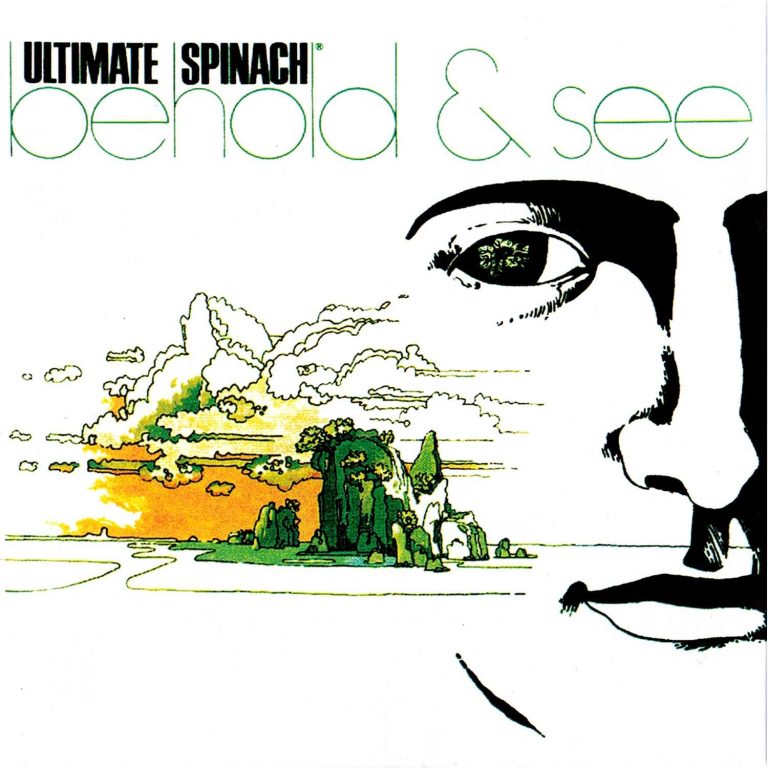
There’s something quietly fascinating about Behold & See, an album caught in the slipstream of its own moment, arriving just as the carefully manufactured glow of the “Bosstown Sound” began to flicker and collapse. If Ultimate Spinach felt like a band being positioned, packaged, and projected outward, Behold & See feels more like something folding inward—fractured, uncertain, and at times, strangely intimate.
Released later in 1968, Behold & See finds Ultimate Spinach still orbiting the era’s psychedelic vocabulary, but with less of the lush, keyboard-driven density that defined their debut. The absence of that sonic anchor is immediately noticeable. Where the first record shimmered with layered textures and studio trickery, this one feels more exposed—guitars pushed forward, arrangements looser, the edges less concealed.
At the center remains Ian Bruce-Douglas, whose songwriting continues to drift between the abstract and the quietly political. The anti-war undercurrent is still there, but it’s less cloaked in surrealism and more embedded in the album’s uneasy tone. There’s a sense of disillusionment threading through these songs—as if the dream, once vividly imagined, is beginning to show its seams.
And yet, for all its perceived shortcomings—its lower chart performance, its critical ambivalence—Behold & See has a peculiar gravity. It doesn’t attempt to replicate the wide-eyed wonder of West Coast psychedelia in quite the same way. Instead, it lingers in a more uncertain space, where imitation gives way to fragmentation. The “San Francisco Sound” is still a reference point, but here it feels more distant.
There are moments where that rawness works in the album’s favor. The stripped-back arrangements allow Bruce-Douglas’ melodies to surface in unexpected ways, and the guitar work—still colored by fuzz, feedback, and subtle modulation—feels less ornamental and more searching. It’s not as immediately immersive as the debut, but it reveals itself in fragments.
Behind the scenes, tensions were already surfacing. The Bosstown campaign—largely driven by producer Alan Lorber—had begun to draw skepticism, and Douglas himself would later express frustration with how the band’s music had been shaped and marketed. That friction is almost audible here. Behold & See doesn’t sound like a product of confident direction—it sounds like an album pulled between competing visions.
In that sense, its flaws become part of its identity. This isn’t a record that fully lands—it wavers, it drifts, it occasionally loses its footing. But it’s also a document of a band (and a scene) in transition, caught between the idealism of psychedelia’s peak and the comedown that inevitably followed.
If the debut was a statement, Behold & See is a question: less cohesive, less celebrated, but perhaps more revealing because of it.
Check out more classic album reviews here


Leave a Reply